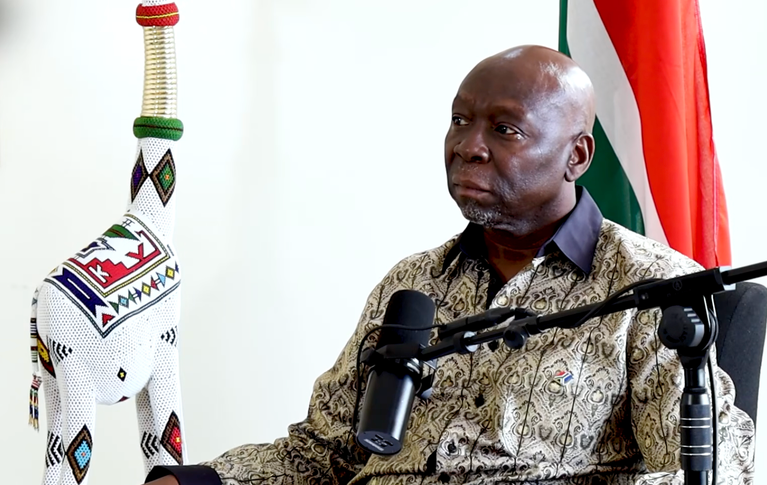
South Africa’s newly appointed Ambassador to Rwanda, Tinyiko George Hlungwane, has announced that his country has begun technical preparations to resume issuing visas to Rwandan citizens holding ordinary passports, more than a decade after restrictions were introduced.
The move is part of broader efforts to restore relations between the two countries, following a meeting between Rwanda’s Minister of Foreign Affairs and International Cooperation, Olivier Nduhungirehe, and his South African counterpart, Ronald Lamola, in Pretoria on June 17 this year.
During the meeting, the two ministers agreed to resume visa issuance for Rwandans holding ordinary passports within 12 months.
Ambassador Hlungwane said the decision to lift the restrictions had already been made, with the remaining work focused on technical arrangements.
“The decision to remove the restriction [on issuing visas] has been taken. So, what remains on the technical side now is to finalise the digital system,” he said.
South Africa introduced restrictions on issuing visas to Rwandans holding ordinary passports in 2014, affecting many travellers, including students and businesspeople.
Hlungwane said preparations were underway to implement a digital immigration system designed to simplify visa processing and eliminate paper-based applications. The system is currently being tested in selected countries.
The new arrangement is intended to enable applicants to apply for and obtain visas electronically, reducing the need to visit embassy offices in person.
The ambassador said his government hoped the digital system would be fully operational within 12 months. If technical challenges persist, alternative arrangements will be introduced to ensure Rwandans can apply for visas within the agreed timeframe.
“Once the system reaches a point where we are satisfied that there are no problems and that it is working properly, an announcement will be made. That could be in December, or it could be in June,” Hlungwane said.
The planned easing of visa restrictions is one of several signs of improving relations between the two countries.
During their meeting, the two foreign ministers also agreed to revive the Joint Commission of Cooperation (JCC), which is expected to convene in Kigali in 2027.
Preparations to reactivate the commission are already underway. It will bring together government institutions and representatives of the business community.
The commission is expected to meet no later than the first quarter of next year to discuss cooperation in sectors including agriculture and infrastructure, with particular emphasis on justice and security. These areas have been at the centre of longstanding disagreements that contributed to the visa restrictions introduced in 2014.
On judicial cooperation, Ambassador Hlungwane said the two countries intended to involve their respective justice institutions in the commission’s work.
“We expect the justice institutions to be part of this commission. Rwanda’s justice sector will meet with its counterparts, put all the legal issues they wish to raise on the table, and then both sides will agree on a memorandum of understanding (MoU) outlining how those issues will be addressed,” he said.
His remarks also touched on the longstanding issue of individuals wanted by Rwanda who have been granted asylum in South Africa.
Hlungwane acknowledged that his government was aware of Rwanda’s strong desire to have these individuals brought to justice. However, he noted that although South Africa adheres to international conventions governing refugees, this does not give anyone the freedom to threaten the security of another country.
“What I can assure you is that, as a country, we have a firm position that we will never allow any group to organise itself under our watch to destabilise another country. We monitor them. We have told them that they will never be allowed to organise themselves on our territory with the aim of overthrowing a government,” he said.
In a further indication of South Africa’s political commitment to rebuilding relations, Hlungwane revealed that his country had begun increasing staffing at its embassy in Kigali, from four employees to five. Another senior diplomat is expected to join the mission next year.