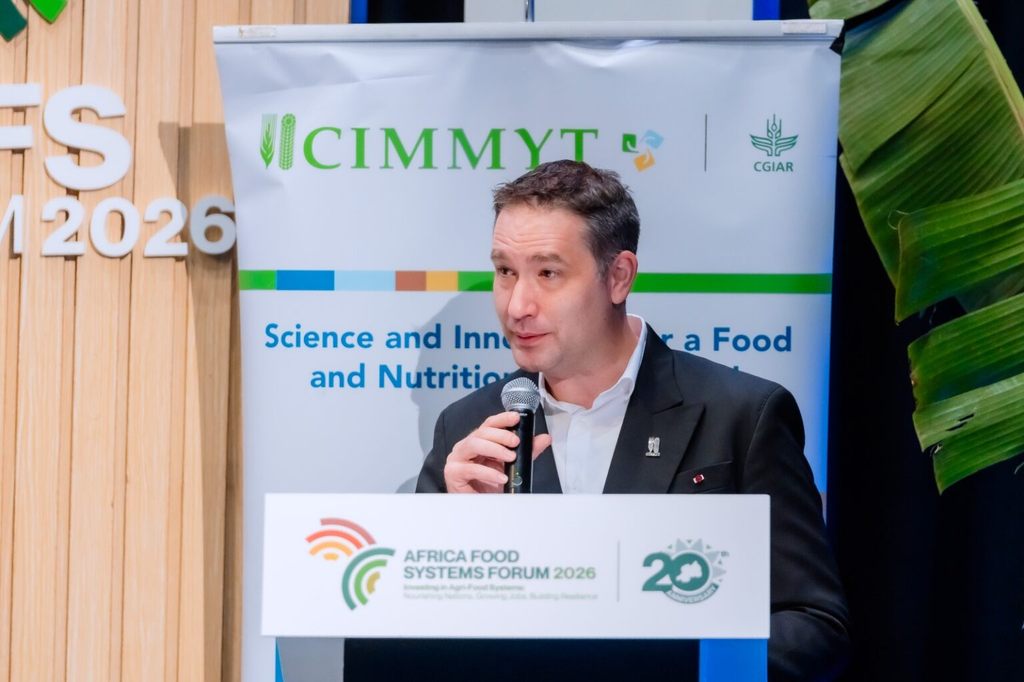
KIGALI, Rwanda, 31 August 2026 — Africa already has many of the agricultural innovations needed to withstand worsening climate shocks, conflict and disruptions to global food and fertilizer markets. The urgent challenge is getting those solutions to farmers quickly and at scale, CIMMYT Director General Dr. Bram Govaerts told the Africa Food Systems Forum (AFSF) 2026 in Kigali.
Speaking at a CIMMYT side event, Securing Africa’s Food Future: The Missing Middle — Scaling Innovation for Food Security, Improved Nutrition and Livelihoods, Govaerts said the continent must close the gap between scientific discovery and delivery if it is to stop repeatedly falling back into emergency response.
The challenge is increasingly urgent. Some 167 million people across Africa faced acute food insecurity last year, he said, with about 80 percent living in countries affected by acute or ongoing conflict.
Behind those figures, Govaerts said, are farmers deciding whether they can afford to plant, families selling livestock to buy food, and communities trying to maintain agricultural production amid drought and conflict.
But he cautioned against portraying African agriculture only through the lens of crisis.
“Africa’s food-security story cannot only be a story of crisis,” Govaerts said, arguing that many of the technologies and approaches required to build greater resilience already exist.
For CIMMYT, which has spent decades developing improved maize and wheat varieties and agricultural technologies able to withstand drought, heat, pests and diseases, the challenge is no longer simply one of scientific discovery.
It is what Govaerts described as the “missing middle” — the financing, seed systems, markets, extension services, policies, businesses and delivery networks needed to move innovations from research institutions into farmers’ fields.
The discussion comes as African food systems confront increasingly interconnected shocks.
Climate extremes are disrupting harvests, conflicts are displacing farming communities, while global fertilizer and energy disruptions have exposed the continent’s dependence on international supply chains.
CIMMYT argued that agricultural preparedness must therefore begin before the next crisis.
Govaerts pointed to anticipatory action taken ahead of the 2023–2024 El Niño, when CIMMYT and partners worked to deploy drought-tolerant maize in countries including Zambia, Malawi and Tanzania before the worst impacts materialized.
He also cited Sudan, where CIMMYT and partners have continued supporting agricultural production despite conflict, including assistance reaching approximately 94,000 farmers and helping sustain food production for communities hosting internally displaced people.
The lesson, he said, is that agricultural systems can continue functioning during severe shocks when science, financing, institutions and delivery mechanisms are connected early enough.
The concern is that comparable preventive action is not yet happening at the scale required for emerging risks.
Govaerts called for action across three horizons: immediate measures to keep farmers producing today, stronger delivery systems over the next 24 months, and longer-term investment over the next five years to reduce the need for repeated emergency interventions.
Former AGRA President Dr. Agnes Kalibata, delivering the keynote address, said Africa’s food systems have faced successive shocks since the global food crisis of 2008 — from droughts and floods to COVID-19, the Russia–Ukraine war, fertilizer disruptions and conflicts across the continent.
COVID-19, she said, demonstrated that food security is not simply about whether food is produced. Restrictions at borders and ports showed that food can exist while people still struggle to access it because transport, storage, logistics and markets are not functioning.
Kalibata warned that governments cannot continue directing an increasing share of scarce agricultural resources towards managing emergencies.
While fertilizer subsidies, food subsidies and social protection may be necessary during crises, long-term resilience requires investment in agriculture as a productive economic sector capable of generating food, income and employment.
She said CGIAR and centres such as CIMMYT have accumulated decades of scientific knowledge, genetic resources, breeding capacity and partnerships across Africa. The priority now is connecting that science to the systems capable of commercializing and delivering it.
That message was reinforced by representatives from the African Development Bank, AGRA, Sasakawa Africa Association and African seed companies.
Dr. Innocent Musabyimana, representing the African Development Bank’s Technologies for African Agricultural Transformation initiative, said technologies are available, but reaching millions of farmers remains a major challenge.
He pointed to the Bank’s USD 1.5 billion African Emergency Food Production Facility, which supported 35 African countries following recent global food and fertilizer shocks.
Working with CGIAR centres and other partners, the initiative supported access to quality and climate-resilient seed, fertilizer, technical assistance, digital systems, finance and policy measures — demonstrating what becomes possible when science is linked to investment and national delivery systems.
For Evelyne Lusenaka of AGRA’s Center of Excellence for Seed Systems in Africa, the challenge is particularly visible in seed systems.
Africa has made significant progress in developing improved varieties and local seed enterprises, she said, but farmers still struggle with inadequate early-generation seed, counterfeit products, weak distribution networks and poor access to information.
Developing a better variety is therefore only the beginning. Research must connect with seed companies, finance, distribution networks, farmers and markets.
Dr. Mel Oluoch of Sasakawa Africa Association argued that agricultural extension must also become a first line of resilience rather than a mechanism that activates only when projects arrive.
Extension systems, he said, should help farmers interpret climate information, select appropriate varieties, manage soil and water, access finance and connect with markets — while also feeding farmers’ experience back into research.
From the private-sector perspective, Mutande Kosta Tembo of Afriseed warned that a bad agricultural season can affect seed availability well beyond a single harvest.
Seed companies therefore need resilient varieties, working capital, insurance, reliable distribution networks and stronger partnerships if they are to prepare for shocks before planting windows close.
The discussion also placed Africa’s young population at the centre of the solution.
In her closing reflections, Wambui Chege argued that young people should not be treated simply as beneficiaries of agricultural development but as entrepreneurs and innovators capable of building the businesses and services that connect science to consumers.
That could turn one of Africa’s biggest agricultural weaknesses into an economic opportunity.
The “missing middle” needs seed multipliers, extension providers, digital services, logistics companies, processors, distributors, financial services and other enterprises — many of which could create dignified employment for young Africans.
For CIMMYT, this is also why resilience cannot be separated from livelihoods, nutrition and economic development.
Closing the session, Govaerts identified climate, conflict and connectivity as three defining risks facing African food systems, with youth employment adding another urgent dimension.
He called for investment across the agricultural system — from genetics, seed and soil fertility to fertilizer, markets, finance, insurance, extension and post-harvest infrastructure.
Rather than designing agricultural systems for normal conditions, he said, countries and their partners should “stress-test” investments against the shocks they are increasingly likely to face.
The central message from Kigali was that Africa is not starting from zero.
The continent already has scientific expertise, technologies, farmers’ knowledge, businesses, financial mechanisms and delivery models. What remains fragmented is the system connecting them.
CIMMYT is calling for those pieces to be brought together at much greater speed — potentially through a coordinated deployment effort involving governments, research institutions, development banks, the private sector and other partners.
For Govaerts, closing the missing middle is ultimately more than a question of agricultural efficiency. When proven technologies exist but cannot reach farmers because financing, markets or delivery systems fail, the consequences are measured in lost harvests, livelihoods and food security.
And with the next shock unlikely to wait for the next research cycle, the message from CIMMYT was clear: Africa does not need to wait for solutions. It needs to get the solutions it already has moving.