
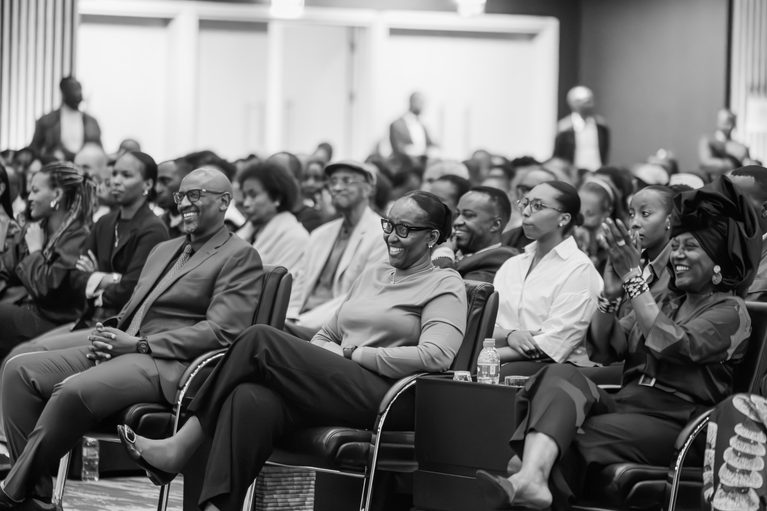
The French-language performance, titled ‘Carte d’Identité’, used comedy, storytelling and impersonations to explore Rwanda’s history, the artist’s family experience in exile and the country’s liberation struggle.
First Lady Jeannette Kagame attended a comedy performance titled Carte d’Identité on Saturday, November 7, 2026, by Rwandan comedian Ntarindwa Diogène, popularly known as Atome, who used humour to share stories about Rwanda’s history, his family’s experience in exile, and the liberation struggle.
The performance took place at the Kigali Convention Centre and attracted several dignitaries and comedy enthusiasts, particularly young people. Atome spent 15 years developing the production.
Performed in French, the one-man show combined humour, storytelling and remarkable impersonations of different characters, allowing the comedian to present historical events through the experiences of his family.
Atome portrayed several people on stage, including his father, Philippe Niwemuto, his late mother, Kabanyana Savela, and other individuals whose lives were shaped by Rwanda’s history.
Through these different characters, he narrated how his father and mother fled Rwanda and initially sought refuge in what was then Zaire, where they encountered war before eventually moving to Burundi.
It was in Burundi that Atome was born and raised.
He also explored how, despite his family having established a relatively comfortable life in Burundi, they continued to hope for an opportunity to return to Rwanda. However, the authorities in Rwanda at the time maintained that the country was already full.
The performance further examined Atome’s perspective on the liberation struggle, highlighting the difficult conditions experienced by soldiers, the sacrifices they made and the consequences the conflict had on some of those involved before Rwanda was liberated.
He also addressed the experiences of people who suffered during the 1994 Genocide against the Tutsi, presenting some of these painful historical realities through theatrical storytelling.
Atome Uses Comedy to Teach Young People Rwanda’s History
Explaining the motivation behind the production, Ntarindwa said he wanted to find a way of helping young people understand Rwanda’s history through an engaging approach that would capture their attention.
He said the idea emerged after observing discussions about history and public awareness campaigns on social media and reflecting on how similar messages could be communicated more effectively to younger generations.
“I had been seeing these stories on social media, particularly those related to history and campaigns encouraging people to stop drinking alcohol. I started asking myself how I could help young people understand these historical stories in a way that would make sense to them. That is when I came up with the idea of creating this performance,” he said.
Atome also explained why he chose to perform all the characters himself rather than bringing in other actors.
He said the characters represented people whose experiences he personally understood, making it important for him to portray their lives from his own perspective.
“The person I was portraying was my own father. There were also scenes where I played my mother, who has since passed away, as well as someone who was blinded by explosions and another person who lost a leg. I felt that I needed to portray their lives myself because I knew their experiences,” he explained.
Audience Members Highlight the Power of Comedy in Preserving History
The performance also generated reflections among audience members, particularly on how artistic expression can help younger generations engage with difficult historical subjects.
Alika Nyanja Karemera, who attended the show, said comedy can serve as an effective tool for communicating painful historical experiences to young people.
“Comedy can be a powerful way of bringing difficult histories to people. It helps young people understand them, become more curious and look at things from a different perspective,” she said.
Israel Nturo Mupenzi also emphasised the responsibility of young people to learn from history and contribute to building a better future.
“First, I would say that we are not responsible for what happened in history before our time, but we have a responsibility for what happens today and what will happen in the future. History is not just something to remember; we must also learn lessons from it and use them as a foundation for building a better future,” he said.
Atome Introduces ‘Legacy Series’ Project Planned for 2027
During the event, Atome also offered the audience a preview of an upcoming artistic project titled Legacy Series, which he plans to develop in 2027.
He presented a segment called Sound Track, featuring songs inspired by Rwanda’s liberation struggle, accompanied by performances and artistic representations of the experiences soldiers went through.
The planned project seeks to continue communicating Rwanda’s history through different artistic forms, including music, drama and theatrical performances.
Through Carte d’Identité and the upcoming Legacy Series, Atome is exploring how creative storytelling can help preserve historical experiences and make them accessible to younger generations.
The production demonstrated how comedy can go beyond entertainment to create opportunities for reflection, historical learning and conversations about Rwanda’s past and the responsibilities of future generations.
KIGALI TIMES