
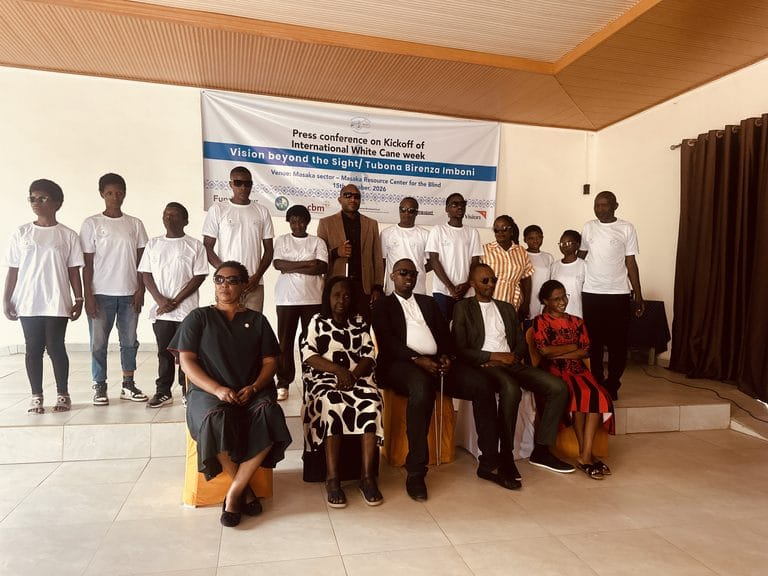
People who are blind or visually impaired in Rwanda are calling for more affordable white canes and a change in public attitudes to ensure they enjoy equal opportunities in education, employment, and other areas of development.
The call was made on October 15, 2026, during the launch of the 18th International White Cane Week, an initiative aimed at raising awareness about the importance of white canes and promoting the rights of people with visual impairments.
This year’s theme, “Vision Beyond the Sight,” highlights the need to recognise people’s abilities beyond their visual limitations and ensure that everyone has equal opportunities to learn, work and contribute to national development.
A white cane is an essential mobility aid that enables people who are blind or visually impaired to navigate their surroundings, identify obstacles and move around independently. It also helps alert others that the user has a visual impairment and may need assistance.
High Cost Remains a Barrier
Jacques Mugisha, Executive Secretary of the Rwanda Union of the Blind (RUB), said the white cane is an internationally recognised mobility aid that should be treated as an essential tool for people with visual impairments.
He explained that although white canes enable users to move around independently, their high cost remains a major challenge, with one cane costing up to Rwf 50,000.
Mugisha noted that white canes do not last forever and may need to be replaced after approximately three years, depending on how they are used. This makes affordability and access to replacement canes particularly important.
He said improving access to white canes would enable people with visual impairments to participate more freely in daily activities without constantly depending on someone to accompany them.
Mugisha also called for a change in attitudes towards people with visual impairments, urging society to recognise their abilities and potential to learn, work and achieve their goals when provided with the necessary support.
Calls for Equal Opportunities
Papy Sibomana, a teacher with a visual impairment, said misconceptions within society continue to prevent some people with visual impairments from enjoying their full rights and opportunities.
He stressed that they should have the same opportunities as other Rwandans to access education, employment, religious activities and participation in national development.
“People with visual impairments should have the right to study, work, worship and participate in the development of the country,” Sibomana said.
He explained that people with visual impairments are trained in various income-generating activities to promote self-reliance. These include soap-making, tailoring, massage therapy, preparing and lighting cooking stoves, and poultry farming through cooperatives.
According to Sibomana, these activities demonstrate that people with visual impairments can improve their livelihoods, support their families and contribute to national development when given appropriate opportunities and support.
White Canes Alone Cannot Address Every Challenge
Dr Betty Mukarwego, Director General of RUB, said that while white canes are essential for independent mobility, they cannot address all the challenges faced by people with visual impairments.
She gave the example of a teacher with a visual impairment who may need assistance reading students’ examination papers and other assignments in order to mark them.
She added that when people with visual impairments travel to other districts, they may also need to hire someone to assist them, creating additional expenses.
These challenges highlight the need for broader measures beyond distributing white canes. Such measures should include accessible services, appropriate workplace support, and improved mobility so that people with visual impairments can carry out their daily activities without unnecessary barriers.
Dr Mukarwego called for stronger efforts to make white canes more accessible and affordable locally, rather than relying on expensive imports.
White Cane Distribution Efforts Continue
Efforts to support people with visual impairments are ongoing. A total of 395 white canes were distributed in 2025, while between 150 and 200 more are expected to be distributed under the subsequent programme.
White canes are also being distributed in different parts of the country to help users move around safely and independently. In Muhima Sector, for example, 45 white canes were distributed.
Data from Rwanda’s 2022 Population and Housing Census indicate that more than 100,000 people in the country have visual impairments.
Participants at the launch of International White Cane Week called for the distribution programme to continue alongside public awareness campaigns aimed at changing attitudes towards people with visual impairments.
They emphasised that supporting people with visual impairments should go beyond providing mobility aids. It should also involve improving their access to education, employment, public services and other opportunities that enable them to participate equally in national development.
ALICE Dusabimana – KIGALI TIMES