
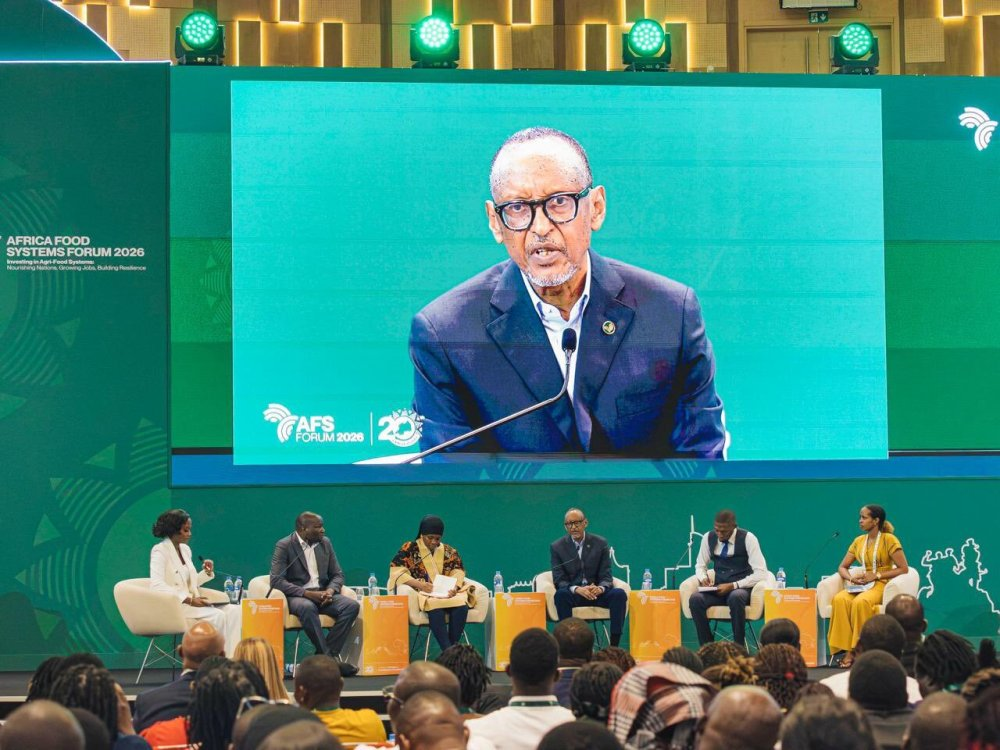
KIGALI, Rwanda — September 3, 2026 — President Paul Kagame has called for reforms to Africa’s financing systems to ensure that young people and other entrepreneurs with viable business ideas can access the capital they need to start and expand their ventures.
Kagame said Africa faces a persistent problem where access to finance often favours people who already have money and assets, leaving those who need capital to establish businesses struggling to secure loans.
He made the remarks during a dialogue with young people at the Africa Food Systems Forum 2026 in Kigali, where participants discussed food security and ways of building systems that can enable more Africans to access food and economic opportunities.
Kagame said access to food should be viewed as more than a human right because food is essential to human survival.
“Having food is beyond a human right. It is life, because a person cannot live without food,” he said.
He explained that achieving food security requires an entire chain, from production and processing to storage, transportation, markets and the final consumer.
“Preparing it must happen. We all have to find ways of producing, but there are challenges in the value chain,” Kagame said.
The President acknowledged the efforts of young Africans who are trying to develop solutions that can improve food production and availability, but said many face barriers that require government intervention.
He said governments have a responsibility to remove obstacles preventing capable entrepreneurs from turning their ideas into businesses.
“Leaders should remember that holding the hand of people who want to do something and have the capacity but are missing small things… government should find ways of removing barriers to many things,” Kagame said.
He argued that governments can establish mechanisms to provide targeted support to entrepreneurs, with the expectation that successful businesses will eventually generate returns for both the entrepreneurs and the wider economy.
Kagame said even where government-backed loans or other financial support do not immediately return, governments should find ways to recover the resources while ensuring that young people with the capacity to create businesses are not left behind.
He was responding to a question about how capable young people who struggle to access finance can obtain the capital needed to start businesses.
According to Kagame, Africa’s financial systems have largely been structured in a way that gives greater access to people who already possess financial resources.
“The financial system in Africa is structured in a way that gives money to those who have it.”
He called for governments to play a stronger role in addressing this imbalance and creating mechanisms through which people without sufficient collateral or financial resources can access appropriate financing.
Kagame cited Rwanda’s Rwanda Development Board (RDB) as an example of an institution through which government and development partners can contribute resources to support entrepreneurs and attract investment.
He said such mechanisms can help bridge the gap for young people who have the willingness and ability to work but lack the initial capital required to establish businesses.
The President said government intervention can ultimately benefit both entrepreneurs and the country because supported businesses can grow, generate profits and contribute to economic development.
“Those people who are helped get benefits, grow and do things that benefit themselves and benefit the country and its economy in general,” he said.
The discussion also focused on opportunities available to young entrepreneurs across Africa’s food systems.
Imungana Malikana, a 28-year-old entrepreneur from Zambia who helps people access finance and connect their products to markets, asked Kagame where he would look for opportunities if he were a 25-year-old entrepreneur seeking to contribute to Africa’s food security.
Kagame said entrepreneurs should examine the entire food value chain, rather than focusing only on farming.
“If I had the opportunity at that time as an entrepreneur, I would look from the farm… and go all the way to the final consumer or the market,” he said.
He identified several areas where businesses could be developed, including agricultural inputs, equipment, technology, irrigation and storage.
Kagame said young entrepreneurs should identify opportunities within the value chain that match their skills, knowledge and interests.
He also stressed that food security extends beyond individuals, families and individual countries, reaching regional and international levels.
For young people seeking to enter the sector, he said partnerships, access to credit and government-supported programmes can provide pathways to areas where they can build sustainable businesses.
Another participant, Murekatete Lydia, founder of All Greens, a greenhouse vegetable farming company, asked Kagame about the most important lesson he had learned from Rwanda’s development journey that leaders and entrepreneurs could apply in their own work.
Kagame said there were many lessons, but one of the most important was for every person to take responsibility for the role they have been given.
He said every individual has the capacity to contribute to solving problems, whether as a leader, entrepreneur or citizen.
“Everyone has the ability. They can be a leader if they want to be,” he said.
Kagame urged people to regularly ask themselves what they are doing to address challenges affecting their communities.
“What is your role? Leaders are there to solve problems when they see them.”
He advised people to begin by examining themselves before attempting to solve problems affecting others.
Kagame said this approach was not about being self-centred, but about understanding challenges honestly, identifying their causes and determining which ones should be addressed first.
He said the ability to identify and classify problems, and determine priorities, is available to everyone.
However, he noted that some people fail to use this capacity even though they possess it.
Kagame encouraged young people to develop this mindset early in life, arguing that learning to identify and address smaller challenges can prepare them to tackle more complex problems as they grow.
The President’s remarks came amid broader discussions at the Africa Food Systems Forum on how Africa can mobilise investment, empower young entrepreneurs and strengthen food value chains to turn the continent’s agricultural potential into greater food security and economic prosperity.
KIGALI TIMES