

The Minister of Education, Joseph Nsengimana, stated that the current number of schoolchildren in Rwanda—about 5 million, representing nearly a third of the population—could be a powerful force for peace. He emphasized that if these children are taught to be humane, genocide would never occur again.
He made this statement on Wednesday, April 23, 2025, during a commemoration event where the Ministry of Education (MINEDUC) and its affiliated institutions joined bereaved families to remember those who worked in the education sector and were killed during the 1994 Genocide against the Tutsi.
This marked the 15th annual event by the Ministry to remember the victims, aligning with the 31st national commemoration of the Genocide during Rwanda’s 100-day mourning period.
Minister Nsengimana acknowledged the difficulty of finding the right words to describe the horrors of the Genocide.
He said, “The way the Genocide was planned and executed, the atrocities committed—children, infants, and the elderly killed indiscriminately—these acts are truly beyond description.”
He continued, “When you think about a segment of the population being determined to eliminate another, hope seems lost. But it’s important to remember that another part of the nation stood up in front of the world and stopped the killings. This gives us the confidence that we hold the solutions within us. That’s why we believe genocide will never happen again in this country.”

He noted that the Ministry of Education holds a vital responsibility in shaping future generations. He urged educators to teach students about humanity and the dangers of genocide, to ensure such atrocities are never repeated—either in Rwanda or anywhere else in the world.
“If you reflect on what happened during the Genocide,” he said, “it becomes clear that if education had fulfilled its role, what occurred would not have been possible.”
He added, “We now have about 5 million children in schools. A third of our population is young. If we do our job right and teach them to be humane, no one will ever convince them to repeat what happened in 1994.”
Dr. Gakwenzire Philbert, President of IBUKA—an association advocating for the rights of Genocide survivors—urged scholars and researchers to continue holding accountable those who distort the history of the 1994 Genocide, particularly individuals and groups in European countries.
The commemoration ceremony for former Ministry of Education employees began with a visit to the Kigali Genocide Memorial at Gisozi, where MINEDUC staff and affiliated personnel honored the memory of over 259,000 innocent victims laid to rest there.
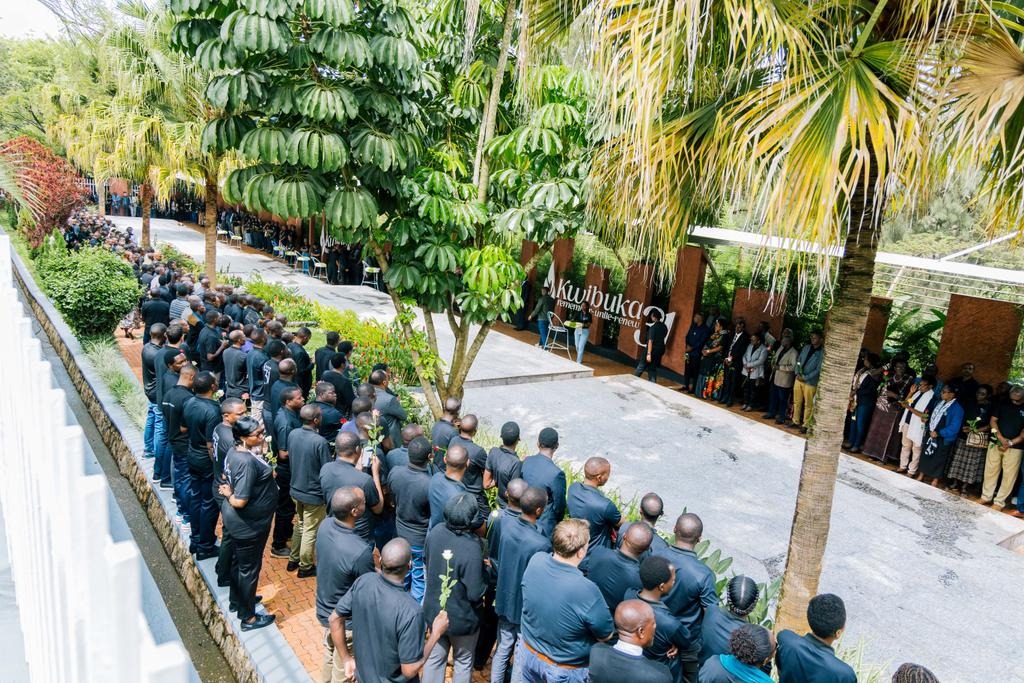
Gabriel UZABAKIRIHO / KIGALI TIMES