
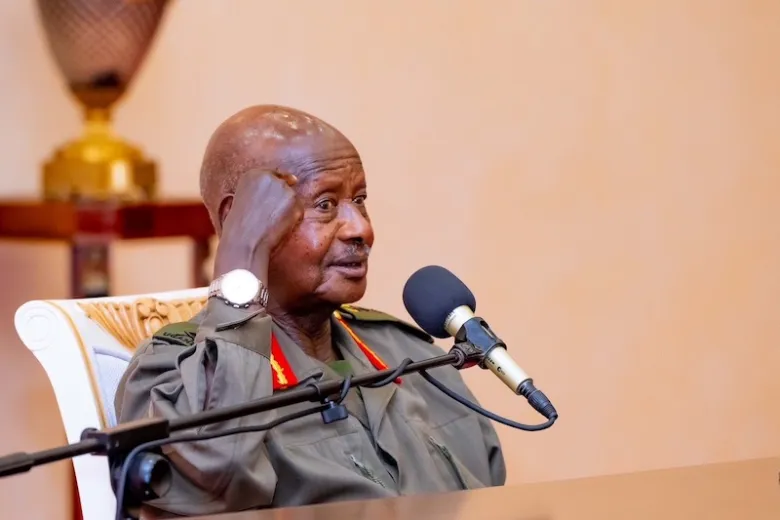
Ugandan President Yoweri Kaguta Museveni has responded sharply to veteran journalist Andrew Mwenda, who recently questioned his leadership and described him as an aging leader no longer capable of effectively governing the country.
Museveni insisted that despite being 82 years old, he remains physically and mentally capable of defending both himself and Uganda if necessary.
Andrew Mwenda, a prominent Ugandan journalist widely regarded as close to the ruling National Resistance Movement (NRM) and a longtime ally of Uganda’s Chief of Defence Forces, General Muhoozi Kainerugaba, recently published a series of criticisms targeting the president.
In an article published by The Independent on April 20, 2026, Mwenda portrayed Museveni as a leader increasingly influenced by powerful business figures. He alleged that businessmen including David Senfuka and Dr. Matthias Magoola, both involved in Uganda’s pharmaceutical sector, had manipulated government officials and secured substantial financial benefits.
On May 13, Mwenda intensified his criticism, arguing that throughout Museveni’s years in power, he had observed a significant gap between the president’s rhetoric and his actions.
“When he speaks, he convinces you. When he acts, you begin to doubt,” Mwenda wrote.
Museveni Responds in Detailed Letter
In a lengthy letter dated May 23, President Museveni dismissed Mwenda’s claims and defended his leadership record.
The Ugandan leader began by addressing the journalist’s remarks about his age, stating that although Mwenda portrays him as physically and intellectually weak, he remains capable of carrying a Bible, a pen, and an AK-47 rifle, and would still be ready to defend Uganda if required.
Museveni challenged Mwenda to thoroughly investigate the issues he criticizes and to pay attention to national development projects such as Kiira Motors, Uganda’s homegrown vehicle manufacturing initiative, instead of what he described as promoting the interests of foreign corporations.
“There are people like Andrew Mwenda who contribute little but spend their time opposing progress and peace. They remain trapped in a neo-colonial mindset that sees Africa merely as a supplier of raw materials for foreign industries,” Museveni wrote.
The president also accused Mwenda of using social media platforms to disclose confidential discussions involving ministers and senior government officials, actions he said could discourage investors and undermine Uganda’s economic development efforts.
“Ugandans should ignore Andrew Mwenda’s statements. They are intended to slow down our development and transformation,” Museveni stated.
Highlighting Uganda’s Economic Progress
Museveni used the letter to showcase what he described as major achievements under his administration.
He noted that Uganda now hosts ten gold-processing factories and that the country’s gold exports have reached approximately $7.48 billion. He further stated that Uganda’s economy is currently growing at an annual rate of 6.3 percent.
The president also highlighted growth in the agricultural sector, saying milk production has increased from about 200 million litres to 5.3 billion litres. He pointed to the establishment of industries involved in juice production, fruit processing, edible oils, coffee processing, and steel manufacturing as evidence of Uganda’s industrial transformation.
Museveni concluded by urging critics to abandon what he termed colonial-era thinking and recognize the progress Uganda has made through local industrialization and value addition initiatives.