
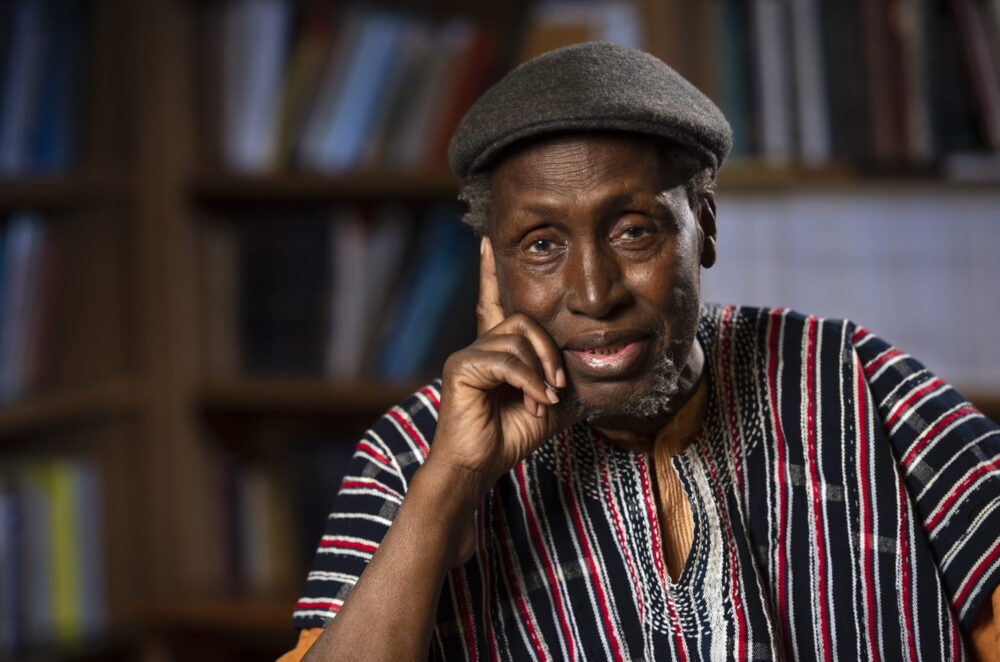
Ngũgĩ wa Thiong’o, a monumental figure in African literature, passed away at the age of 87. His legacy is one of unshakable resilience—undaunted by imprisonment, exile, or illness—and a profound dedication to storytelling rooted in African experiences.
For over sixty years, Ngũgĩ chronicled Kenya’s evolution from a British colony to a sovereign nation. Though widely believed to be a strong contender for the Nobel Prize in Literature, the accolade always eluded him, much to the disappointment of his many admirers. Yet, his influence stretched far beyond awards—he was a fierce advocate for writing in African languages, especially his native Kikuyu.
Born as James Thiong’o Ngũgĩ in 1938, during Kenya’s colonial era, he grew up in the modest town of Limuru in a large farming family. His education was funded through the sacrifices of his parents, which led him to the prestigious Alliance High School. But colonial oppression was never far—he once returned from school to find his village razed and his family displaced into detention camps during the brutal crackdown on the Mau Mau uprising.
The Mau Mau resistance deeply affected Ngũgĩ, especially after his deaf brother, Gitogo, was tragically shot by a British soldier for failing to follow an order he couldn’t hear.
In 1959, as colonial rule weakened, Ngũgĩ traveled to Uganda to study at Makerere University. It was there that Nigerian literary legend Chinua Achebe read his debut novel’s manuscript and helped publish Weep Not, Child in 1964. It became the first significant English-language novel by an East African author. He soon released other celebrated novels like The River Between and A Grain of Wheat, quickly earning recognition as one of Africa’s leading voices.
In 1977, Ngũgĩ underwent a personal and professional transformation. He renounced his colonial name, adopting Ngũgĩ wa Thiong’o, and committed to writing solely in Kikuyu. His final English-language novel, Petals of Blood, released that same year, harshly criticized Kenya’s post-independence elite for betraying ordinary citizens.
Later that year, he co-authored the play Ngaahika Ndeenda (I Will Marry When I Want), highlighting social inequality. The Kenyan government responded by shutting down the play and imprisoning Ngũgĩ without trial for a year. While in prison, he wrote his first Kikuyu novel, Devil on the Cross, reportedly on toilet paper due to lack of proper writing materials.
Although he was freed after Daniel arap Moi took power, Ngũgĩ soon discovered he was targeted for assassination. Fearing for his life, he went into self-imposed exile in the UK and then the United States, where he stayed for 22 years. Upon his return to Kenya, he was welcomed like a national hero. Sadly, the visit was overshadowed by a violent break-in where both he and his wife were attacked—an incident he believed had political motives.
Ngũgĩ later returned to the U.S., continuing his academic career with positions at Yale, NYU, and the University of California, Irvine. In both scholarly and public arenas, he was a steadfast champion of African language literature, challenging the dominance of English and French in African writing.
In his groundbreaking essay collection Decolonising the Mind, he questioned why African writers should rely on colonial languages. “What’s the difference between a politician who claims Africa can’t live without imperialism and a writer who says Africa can’t live without European languages?” he provocatively asked.
His bold stance even led to tensions with Achebe, the mentor who had once boosted his career. Ngũgĩ openly criticized Achebe for continuing to write in English, causing a rift between the two.
Beyond literature, Ngũgĩ’s personal life included two marriages, nine children—four of whom are also published authors—and a few family controversies. His son Mukoma wa Ngũgĩ once publicly accused him of domestic abuse, claims that Ngũgĩ never addressed publicly.
Despite severe health challenges—including cancer, kidney failure, and heart surgery—Ngũgĩ remained active for much of his later life. In 1995, after being given just months to live due to prostate cancer, he defied the odds and recovered.
Now, with his passing, the world has lost one of Africa’s literary beacons. As author Chimamanda Ngozi Adichie once described, Ngũgĩ wa Thiong’o was a guiding light—and his absence leaves an undeniable void in the world of literature.
Gabriel UZABAKIRIHO / KIGALI TIMES