
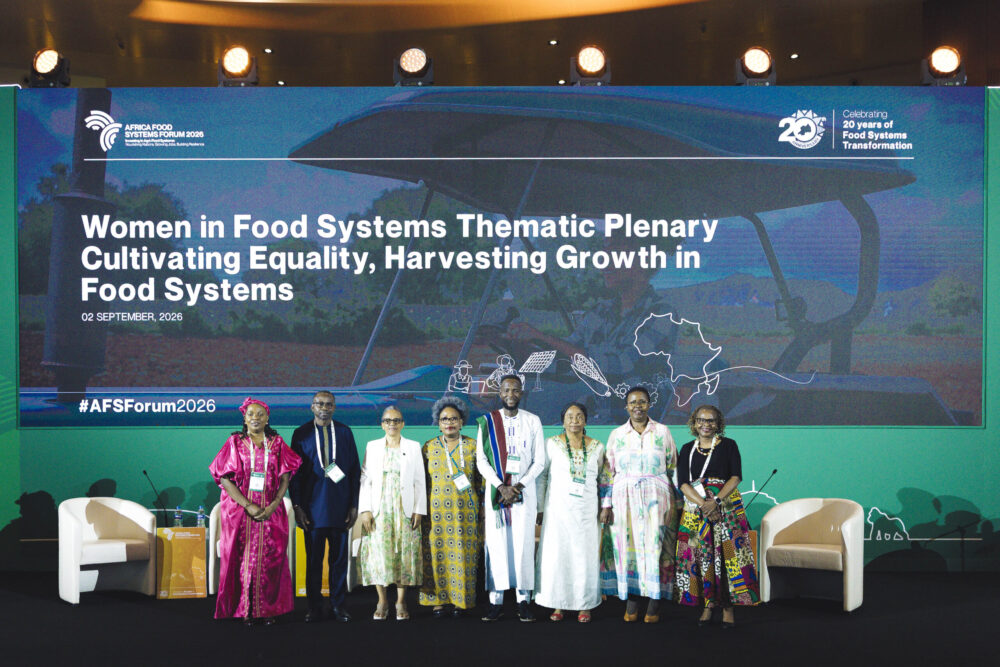
KIGALI, Rwanda — Africa’s food-system transformation will remain incomplete unless women gain greater control over the resources, markets and decisions that shape agricultural and food economies, experts said at the Africa Food Systems Forum 2026 in Kigali.
The session on women in agrifood systems focused on the gap between women’s substantial contribution to food production and their limited access to the opportunities and resources needed to benefit from that work.
Former First Lady of Ethiopia and co-founder of the Lady Mary and Royal Foundation, Her Excellency Roman Tesfaye, said women are already deeply embedded in food systems.
“Women are farmers, livestock keepers, processors, entrepreneurs and caregivers,” she said.
But she argued that participation alone is not enough.
“The issue is not whether women participate in agrifood systems, but whether they have access to finance, technology, markets and voice to benefit from the value they create.”
Tesfaye said barriers affecting women also have consequences for economic growth. Women who have the skills to increase agricultural production or run businesses can remain constrained when they cannot secure land, financing or access to markets.
“A woman may have the skills to increase production, but without access to land, she cannot invest in it,” she said. “She may have a better business, but without finance, she cannot grow.”
She further called for women to be involved in developing solutions rather than being treated solely as recipients of development programmes.
“When women have a voice in designing solutions, they are not simply beneficiaries. They become co-creators,” she said.
Dr. Susan Kaaria, Director of African Women in Agricultural Research and Development, presented findings from a report examining the status of women in agrifood systems across sub-Saharan Africa.
The report, produced by the Food and Agriculture Organization of the United Nations, the Natural Resources Institute of the University of Greenwich and AWARD, examines women’s employment, food security and nutrition, natural-resource rights, innovation, and agency and collective action.
According to the findings, women accounted for 76% of working women employed in agrifood systems in sub-Saharan Africa in 2022, demonstrating their central role in the sector.
However, Kaaria said much of this contribution takes place under insecure conditions.
“Nearly 90% of employed women in the region work in the informal sector,” she said.
Women also carry a disproportionate share of unpaid domestic and care work, reducing the time available for income-generating activities and other opportunities.
The situation becomes more difficult during climate and food crises.
“Climate change is intensifying these inequalities because women are more disproportionately affected by climate change than men,” Kaaria said.
The report found that 64.2% of women and 62.7% of men in sub-Saharan Africa experienced moderate or severe food insecurity in 2024. It also identified persistent gender gaps in land ownership and control, leaving many women with less security to invest in agricultural activities.
The session highlighted the need for governments, financial institutions, private companies and development partners to address these structural barriers.
Among the priorities raised were stronger land rights, better financial services for women, access to technology and markets, safe and decent employment, and measures to reduce the burden of unpaid care work.
The discussion also used art to highlight women’s experiences. Spoken-word artist Grace Kelly Muhuni reflected on the relationship between farming, family responsibilities and the often-unrecognized labour of women.
“You can’t talk about farming without talking about the family,” Muhuni said.
The session concluded with a call for a shift from simply recognizing women’s contribution to creating conditions in which they can own businesses, control productive resources and participate in decisions shaping food systems.
“Let us ensure that the women who feed our markets and sustain our communities can also own businesses, access capital, enter markets, use technology, share decisions and share in the prosperity they create,” Tesfaye said.