
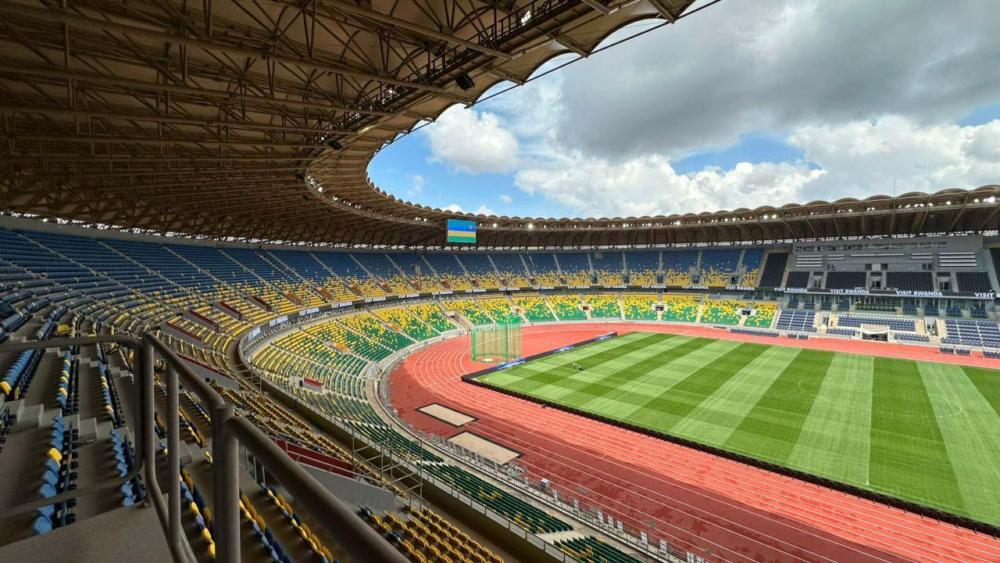
Rwanda’s Amahoro Stadium is set for another major upgrade, with RWF 90.7 billion earmarked for improvements in the 2026/27 financial year, just two years after the facility’s official reopening.
The investment is expected to enhance the stadium’s functionality beyond football and other sporting events, with plans to make it suitable for major entertainment events and to improve the spectator experience.
The refurbished Amahoro Stadium was officially inaugurated on July 1, 2024, in a ceremony attended by President Paul Kagame and CAF President Patrice Motsepe.
With a seating capacity of 45,000 people, the stadium occupies about 75,000 square metres and stands approximately 40 metres high. Its major redevelopment cost about $160 million, transforming it into an international-standard facility designed to meet CAF and FIFA requirements.
However, subsequent use of the stadium has highlighted areas requiring additional improvements.
Bigger screens, better sound
Among the planned upgrades is the expansion of the stadium’s two giant screens.
Spectators have complained that the existing screens are difficult to see clearly from some sections of the stadium, including areas close to the screens. The planned expansion is expected to ensure that people across the venue can follow live action and other information displayed during events.
The VIP section is also expected to undergo improvements. Some spectators have raised concerns that rain can reach certain seats in the area, prompting plans to redesign and improve the section.
Sound quality is another area targeted for improvement. Visitors have previously complained about difficulties hearing announcements inside the stadium, sometimes requiring additional sound systems to supplement the existing equipment.
Stadium to accommodate major concerts
The planned investment will also focus on enabling Amahoro Stadium to host major concerts and other large-scale entertainment events without damaging the football pitch.
The move is expected to diversify the stadium’s sources of revenue while allowing Rwanda to use one of its biggest sports facilities for a wider range of activities.
The stadium has so far hosted sporting activities as its main events, with entertainment activities generally linked to other programmes.
Spider Camera remains operational
Despite reports that the stadium’s high-tech Spider Camera has not been used regularly, officials at the Ministry of Sports say the equipment remains operational and is deployed for selected major events.
The camera, manufactured by Ross Video Ltd., moves above the playing surface using a cable system. It can travel at speeds of up to nine metres per second across an area measuring approximately 250 by 250 metres.
Weighing about 340 kilogrammes, the system is designed to accommodate different professional broadcast cameras and can operate in temperatures ranging from -10°C to 40°C.
The system can be fitted with cameras from manufacturers including Sony, Grass Valley, Panasonic, Hitachi, RED and ARRI, depending on the requirements of an event.
The Amahoro Stadium upgrade forms part of broader government efforts to improve Rwanda’s sports infrastructure and make the facilities financially sustainable.
The 2026/27 national budget also includes more than Rwf1.3 billion to clear construction-related arrears for Ngoma Stadium, another Rwf1.3 billion for Bugesera Stadium and an additional Rwf1.3 billion for Nyagatare Stadium.
The Ministry of Sports says sports facilities should not only serve as public infrastructure but also generate income to contribute towards recovering the investments made in them.
During the 2025/26 financial year, the ministry had targeted at least Rwf5 billion in revenue from sports facilities. It ultimately generated Rwf5.69 billion, with income coming from venues including Huye Stadium, BK Arena, Kigali Pelé Stadium and Amahoro Stadium.
Amahoro Stadium was placed under the management of QA Venue Solutions in October 2025, as part of efforts to improve its commercial utilisation.
The ministry is also continuing to explore partnerships with private operators to manage and commercially develop other sports facilities across the country.
The latest Amahoro Stadium upgrade therefore represents more than a renovation project. It is part of Rwanda’s wider push to turn major sports venues into modern, multipurpose facilities capable of hosting international sporting competitions, concerts and other large-scale events while generating sustainable revenue.
SOURCE: IGIHE