
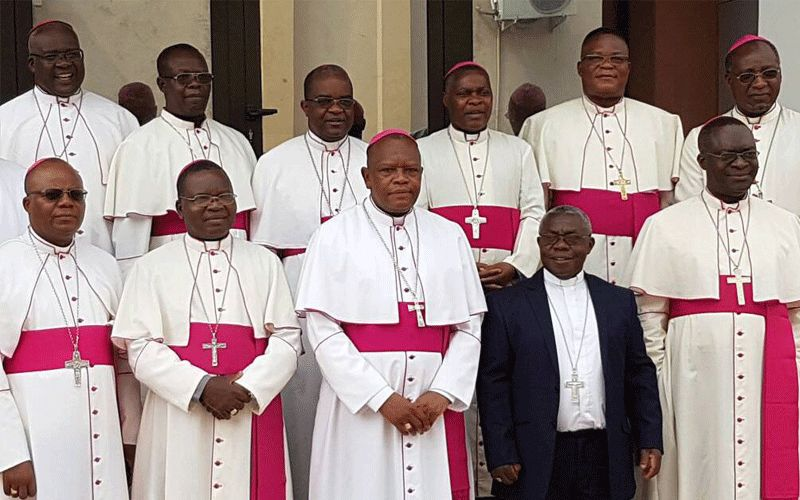
The government of the Democratic Republic of the Congo has openly accused the country’s Catholic bishops of collaborating with former President Joseph Kabila, Paul Kagame and the Alliance Fleuve Congo-March 23 Movement (AFC/M23).
The accusations come amid a growing political dispute over a proposed constitutional amendment that could potentially alter presidential term limits in the DRC.
The National Episcopal Conference of Congo (CENCO) has publicly opposed a referendum proposal approved by members of parliament and senators that seeks to amend certain provisions of the country’s Constitution, particularly those related to presidential mandates.
According to the Catholic Church, some supporters of changing the Constitution of February 18, 2006, have not hidden what it describes as their primary objective:
“To grant additional terms to the current President of the Republic.”
CENCO argued that such a move would violate the country’s republican pact, which was achieved through historic political agreements reached at a high cost after years of crises since the country’s independence.
The bishops also expressed concern that the referendum could further divide the country, especially because some parts of eastern Congo, including the provinces of North Kivu and South Kivu, may not participate in the vote due to ongoing insecurity.
CENCO Secretary-General and spokesperson Bishop Donatien Nshole warned:
“The division of the country would become evident if Congolese citizens elsewhere participate in the referendum while those in North and South Kivu are excluded.”
The bishops’ comments sparked a fierce response from politicians aligned with President Félix Tshisekedi.
On June 23, 2026, members of the Union Sacrée de la Nation, the governing coalition backing Tshisekedi, held a meeting and later issued a joint statement.
Reading the statement, Member of Parliament Jean Baudoin Mayo Mambeke said coalition members were concerned that certain bishops were using language that could incite public unrest and encourage the overthrow of existing institutions.
They reminded the clergy that the Democratic Republic of the Congo is a secular state.
The coalition further alleged that:
“Certain bishops within CENCO, together with Joseph Kabila, Paul Kagame and their partners in M23, should not claim to be the only people with truth and wisdom regarding this critical issue concerning the shared future of all Congolese.”
Mayo added:
“A few bishops cannot replace the institutions of the Republic, the sovereign Congolese people, or the wider Catholic community.”
The debate over constitutional reform has intensified as the country looks ahead to the 2028 presidential election.
Opposition parties have also joined forces under a coalition known as Coalition 64, pledging to do everything possible to prevent any extension of presidential term limits.
The constitutional debate is increasingly becoming one of the most contentious political issues in the DRC, raising concerns about political stability and the future of democratic governance in the country.