
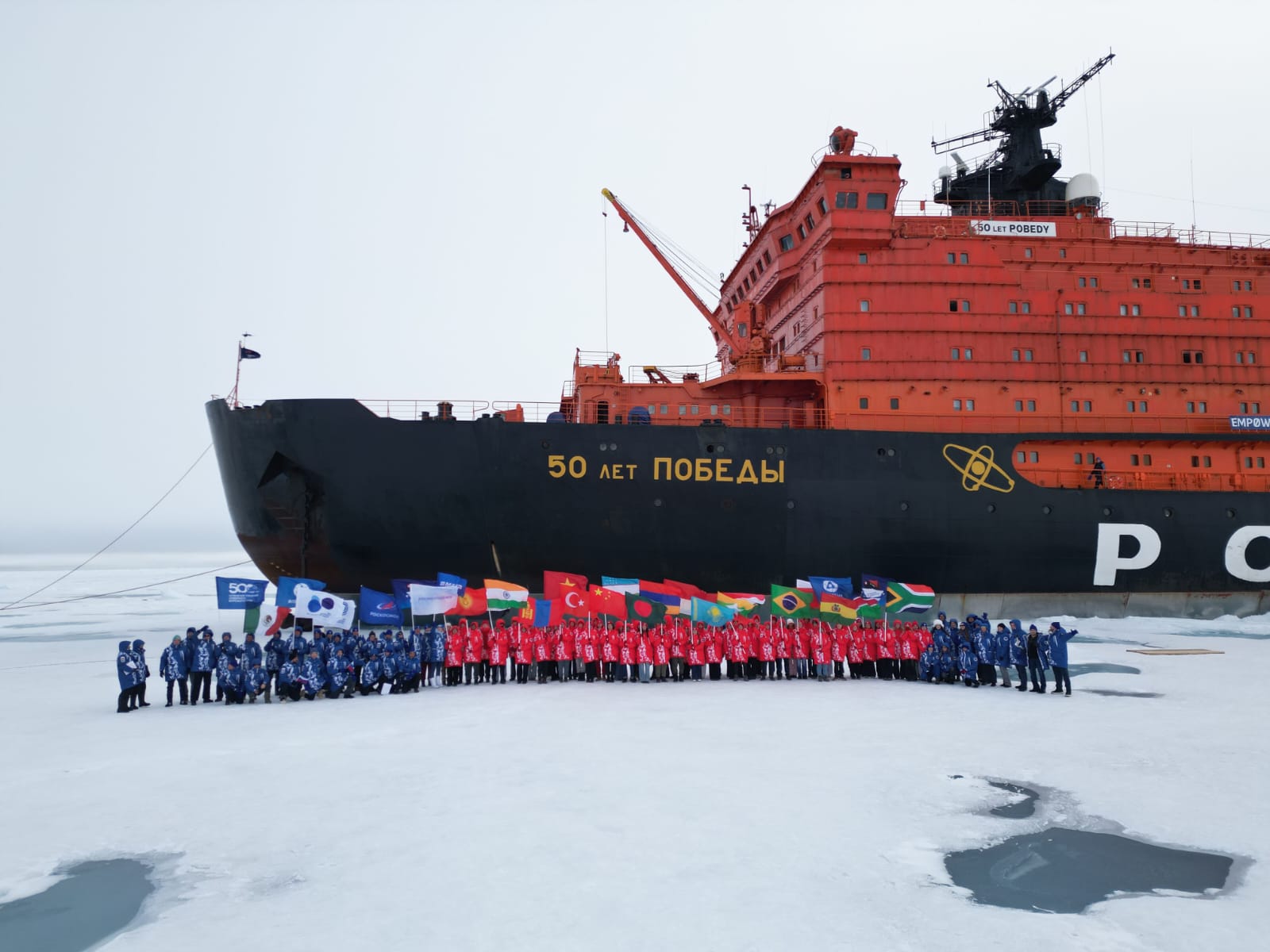
Nearly 5,000 applications and about 200 people per spot – Rwanda debuts in the international expedition to the North Pole
Rwanda has joined the Icebreaker of Knowledge science and education project, organised by Rosatom State Corporation. More than 350 applications came from the African continent alone – representing Rwanda, Tanzania, Namibia, South Africa, and Egypt.
“The competition this year is exceptionally strong, and such a high level of interest shows that science and nuclear technologies today are indeed drawing a tremendous attention of young people around the world,” noted Deputy Director General for Communications at Rosatom International Network (private institution) Alexandra Yustus.
The first stage of the international selection process started on May 5 as a scientific quiz on the goarctic.energy platform. The second stage was opened by a series of webinars from Rosatom experts delivered on promising technologies of the future and Arctic shipping. Based on the combined scores from both stages, 10 finalists were selected in each participating country. The finalists will now complete a creative assignment, which will be evaluated by a panel of nuclear industry experts, considering both the quality of argumentation and the originality of presentation. The authors of the best submissions will set off on a ten-day expedition to the northernmost point of the Earth aboard the nuclear icebreaker 50 Let Pobedy (50 Years of Victory) as early as this August. The names of the winners will be announced on June 23 on the project website.
The international team will bring together participants from 23 countries: Namibia, Tanzania, Rwanda, South Africa, Armenia, Bangladesh, Belarus, Bolivia, Brazil, China, Egypt, Hungary, India, Indonesia, Kazakhstan, Kyrgyzstan, Mongolia, Myanmar, Russia, Serbia, Türkiye, Uzbekistan, and Vietnam.
The Icebreaker of Knowledge is part of Rosatom’s broader educational strategy, which is already delivering tangible results in Rwanda. Currently, 108 Rwandan students are studying at Russian universities in nuclear and related fields. Since 2019, a joint bachelor’s programme “Nuclear Science and Technology” has been running between MEPhI and the University of Rwanda, with around 50 students enrolled each year. In 2025, 9 Rwandan graduates completed their studies at MEPhI, and 18 alumni are already employed by Rwandan specialised organisations.
However, educational initiatives are just one aspect of Rosatom’s cooperation with Rwanda. The state corporation also supports human resources development for nuclear energy and related industries: annual study quotas are allocated (20 quotas via Rosatom for the 2026/2027 academic year), professional development courses are offered, and scholarship programmes are implemented, including the Marie Skłodowska-Curie Fellowship Programme and Rosatom scholarships.
Thus, participation of Rwandan schoolchildren in the Icebreaker of Knowledge is not only a unique opportunity to visit the Arctic. It is a natural step in the long-standing partnership between Rwanda and Russia in nuclear education and technology.
Such projects help identify talented youth, build a talent pool for future nuclear projects in the country, and strengthen long-term scientific and technical cooperation, opening up new prospects for Rwanda in energy, medicine, and industry.Background Information:The Northern Sea Route (NSR) is the shortest shipping route between the western part of Eurasia and the Asia-Pacific region and a historically developed national transportation artery of Russia. Russia’s history of developing the Northern Sea Route spans more than 500 years and dates back to 1525, when Russian diplomat Dmitry Gerasimov proposed the idea of using a shipping route through the seas of the Arctic Ocean.
In 2018, the Government of the Russian Federation granted Rosatom the authority of infrastructure operator of the Northern Sea Route. The corporation supervises the federal project Development of the Northern Sea Route and also participates in implementing the Northern Sea Route Development Plan through 2035 and the Russian Federation’s socio-economic development initiative through 2030 entitled Year-Round Northern Sea Route, approved by an instruction of the Government of the Russian Federation.
Russia is the only country in the world with a nuclear-powered icebreaker fleet. The fleet is operated by FSUE Atomflot, a Rosatom’s enterprise. At present, FSUE Atomflot operates eight nuclear-powered icebreakers.
KIGALI TIMES