
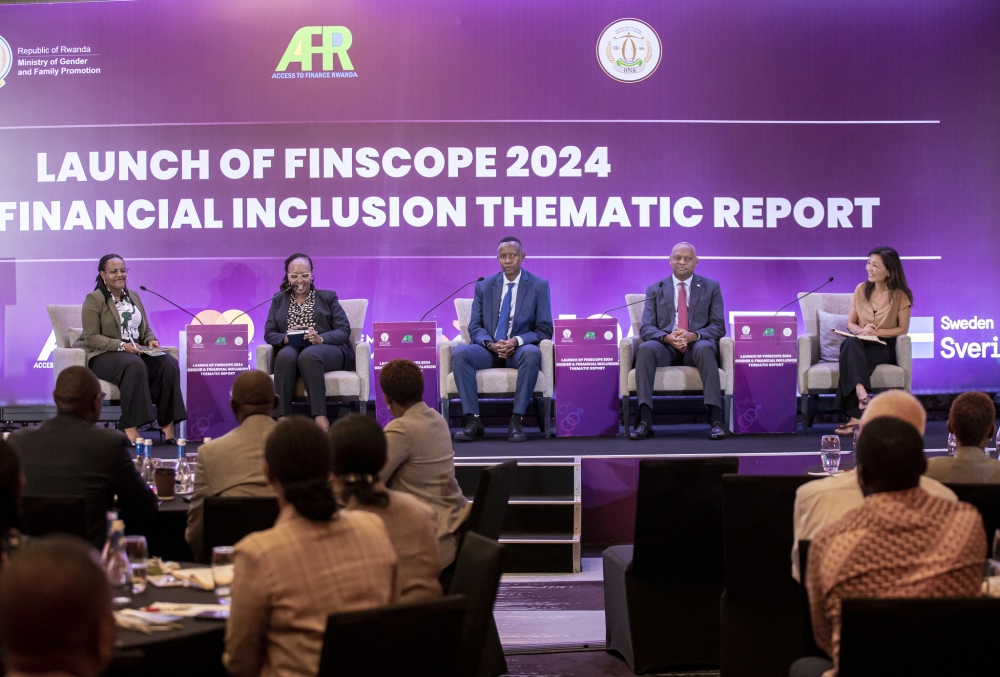
Access to Finance Rwanda (AFR) unveiled the Finscope Gender and Financial Inclusion Thematic Report on March 7, revealing a notable increase in women’s access to financial services—from 92% in 2020 to 96% in 2024. This growth is primarily attributed to the widespread adoption of mobile money, which now reaches 73% of women, up from 55% in 2020. However, challenges persist in women’s use of more advanced financial products, such as credit, insurance, and savings.
The report also highlights a disparity between rural and urban women in accessing formal financial services. While 95% of urban women use formal financial products or services, only 87% of rural women do the same.
The launch event, held at the Kigali Marriott Hotel, brought together key stakeholders from Rwanda’s financial sector, government institutions, development partners, civil society organizations, and gender advocacy groups. The report offers critical insights into gender disparities in financial service usage, supporting Rwanda’s efforts to enhance financial inclusion for women.
Jean Bosco Iyacu, CEO of Access to Finance Rwanda, emphasized the country’s progress in advancing women’s financial inclusion and announced plans to release additional thematic reports. “We have made significant strides in promoting women’s financial inclusion and economic empowerment. Soon, we will launch reports on digital financial services, financial inclusion for refugees, MSMEs, agriculture, and more,” he said.
Iyacu stressed the importance of evidence-based data in shaping interventions and called for continued efforts to promote gender equality in financial access.
Console Uwimana, Minister of Gender and Family Planning, highlighted the significance of the Finscope report, noting that it reflects the challenges and opportunities faced by Rwandan women. She emphasized that access to financial services is critical for women’s economic empowerment, enabling them to manage finances, invest in businesses, and build wealth.
“This report is not just a collection of statistics; it’s about people, their challenges, and their opportunities. Financial inclusion goes beyond access—it’s about ensuring women can fully utilize financial services to bridge economic gaps and achieve sustainable growth,” she said.
Minister Uwimana called for stronger partnerships between the government, financial institutions, and the private sector to develop gender-transformative financial solutions. She also emphasized the need for gender-responsive financial policies, improved financial literacy, and efforts to close the digital divide, particularly in rural areas.
Elisee Kamanzi, Head of Entrepreneurship & Enterprise Growth at the MasterCard Foundation, acknowledged Rwanda’s progress in women’s financial inclusion, crediting technology, especially mobile banking, for expanding access to underserved communities. “While we celebrate the progress, we must also address remaining barriers, such as the need for equitable policy actions,” he said. Kamanzi urged collaboration among stakeholders to achieve full financial inclusion.
Valence Kimenyi, Director of Financial Sector Development and Inclusion at the National Bank of Rwanda, highlighted the progress made in narrowing the gender gap in financial inclusion. He envisioned a future with zero gender disparities in financial access, stating, “There is no reason for women to have less access to financial services than men. Achieving this goal will require innovation and a gender-focused approach.”
The Finscope Survey, conducted every four years since 2008, is a collaborative effort by Access to Finance Rwanda, the Ministry of Finance and Economic Planning, the National Bank of Rwanda, and the National Institute of Statistics of Rwanda. It provides comprehensive insights into various aspects of Rwanda’s financial sector.