
African countries are stepping up efforts to avoid being added to — or returning to — the Financial Action Task Force (FATF) grey list, a designation that flags weaknesses in combating money laundering and terrorist financing.
Although less severe than blacklisting, grey-listing signals heightened financial risk. It often triggers tighter scrutiny from global banks and investors, slowing cross-border transactions and making it harder for businesses to secure international financing.
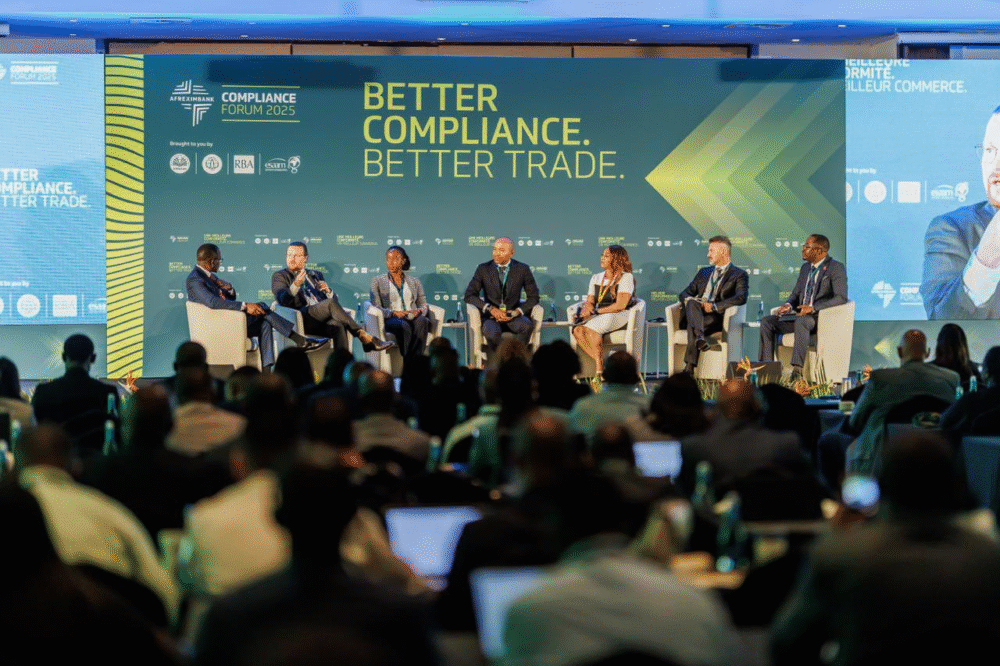
These concerns took centre stage at the Afreximbank Compliance Forum held in Kigali this week, where regulators and policymakers urged stronger collaboration and sustained political will to safeguard financial systems.
Several countries — including Nigeria, Senegal, and Côte d’Ivoire — have previously appeared on the grey list but managed to exit after undertaking wide-ranging reforms. Officials cautioned, however, that staying compliant requires long-term dedication and multi-sector coordination.
“It’s not enough for African countries to simply adopt global standards. Each country must take ownership and ensure these measures are effectively applied across all sectors,” said Edwin Harris Jr., Director General of the Inter-Governmental Action Group against Money Laundering in West Africa (GIABA).
He stressed that compliance cannot rest on one institution alone. “Regulators, banks, and all stakeholders must be engaged. Adapting these frameworks to local realities is essential for protecting our financial systems and preventing a return to the grey list.”
Harris added that GIABA has expanded its capacity-building programmes, offering member states technical support to strengthen domestic oversight and avoid grey-listing.
Sharing Nigeria’s experience, Felix Obiamalu, General Counsel of the Nigerian Financial Intelligence Unit (NFIU), said the country’s multiple listings were a turning point that pushed deeper institutional reforms.
“Nigeria has appeared on the grey list three times. We built reforms that could survive political transitions. Passing laws wasn’t the hardest step — making sure they worked was,” he said.
Afreximbank’s Compliance Director, Idris Diop, noted that the key to avoiding grey-listing lies in strong regulation and effective enforcement of anti-money laundering and counter-terrorism financing rules.
“The grey list is not primarily about sanctions. It’s about gaps in a country’s regulatory framework. Once those weaknesses are addressed in line with international standards, a country can successfully exit,” Diop said.
He pointed to recent examples — including Nigeria and South Africa — that were removed from the grey list after intensifying audits, training financial institutions, and modernising legislation.
Rwanda’s Financial Intelligence Centre Director General, Jeanne Pauline Gashumba, emphasized prevention over cure.
“The best way to exit the grey list is never to be placed on it,” she said. “That requires continuous capacity-building, strong inter-agency cooperation, and transparency in both policy and implementation. Grey-listing can slow investment, increase transaction costs, and damage reputations — effects that may take smaller economies years to reverse.”