
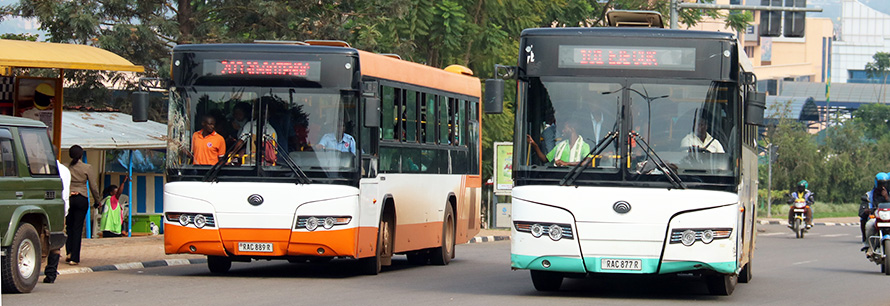
The City of Kigali is placing public transport at the core of its new urban development vision as the government steps up efforts to tackle growing traffic congestion in the capital.
Presenting the National Urbanisation Policy to Parliament on Tuesday, November 11, the Minister of Infrastructure, Jimmy Gasore, said the government’s new approach will prioritise efficient, reliable, and high-capacity transport systems as Kigali continues to expand.
“We are addressing traffic congestion by improving the management of traffic lights, and there is already a plan to connect them all to ensure proper coordination,” Gasore told lawmakers during the Plenary Session of the Chamber of Deputies.
“We are also enhancing the management of road intersections and strongly encouraging the use of public transport,” he added.
In 2023, Rwanda and Japan signed a $14.6 million grant agreement to establish a new Intelligent Transport System (ITS) designed to ease congestion and enhance mobility across Kigali. The project includes the development of a centralised traffic control and signal coordination system, alongside intersection upgrades.
Gasore noted that while congestion cannot be completely eliminated in growing cities, Rwanda aims to significantly reduce it by making public transport the most convenient and efficient choice for commuters.
He revealed plans to introduce modern buses fitted with real-time tracking systems and to expand route coverage to reach every neighbourhood. The minister further stressed that private car use should be a choice, not a necessity, and that the government’s focus is on promoting mass transport solutions that move large numbers of people efficiently.
Beyond buses, the policy promotes workplace car-pooling through shared vans, which will be given priority on the city’s road network.
The City of Kigali had earlier announced plans to pilot Dedicated Bus Lanes (DBL) — road sections reserved for buses to allow faster, more reliable travel and bypass traffic bottlenecks.
The 2025 National Urbanisation Policy, a revision of the 2015 framework, sets out a long-term vision to create well-managed, inclusive, and climate-resilient cities capable of driving economic transformation.
Under the new strategy, Rwanda aims to raise its urban population from 27.9% in 2022 to 52.7% by 2035 and 70% by 2050. Officials say this rapid growth must be accompanied by coordinated spatial planning, affordable housing, modern infrastructure, and efficient mobility systems.
One of the policy’s four key pillars is livability, which focuses on making cities practical, safe, and comfortable for residents. Gasore noted that transport plays a central role in this pillar — improving mobility not only cuts travel time and emissions but also boosts overall productivity and quality of life.