Gabriel UZABAKIRIHO
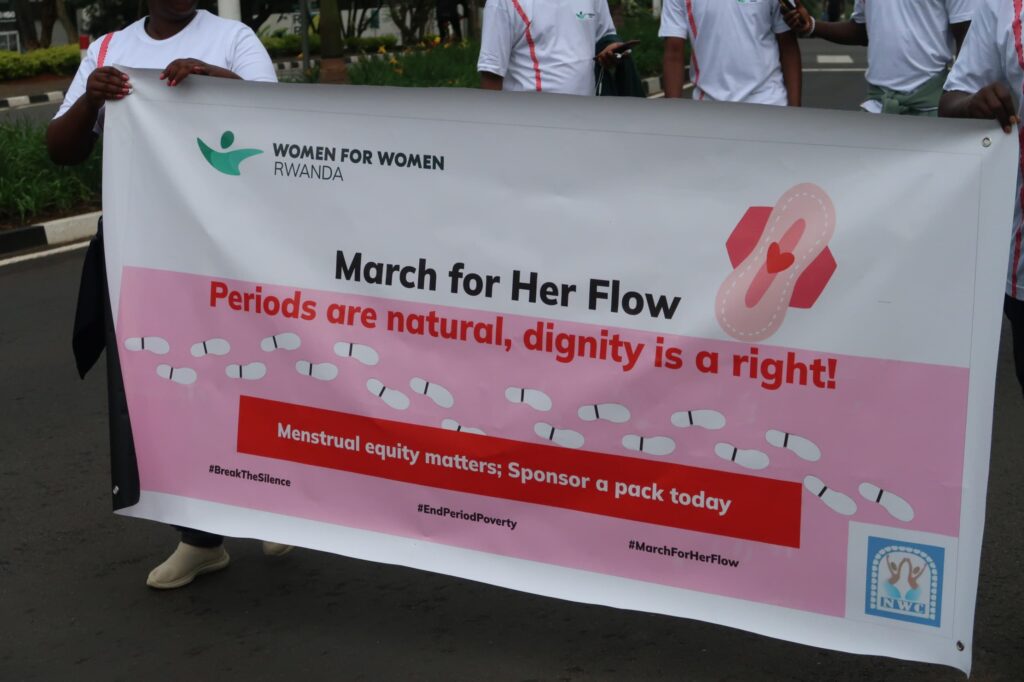
As the world continues to celebrate Women’s Month, Women for Women Rwanda (WfW Rwanda) has launched the “March For Her Flow” campaign. This initiative calls for support in providing menstrual hygiene products to girls especially those in rural areas—who cannot afford to buy pads, ensuring they can manage their periods with dignity and without disruption to their education.
Menstruation is a natural and healthy biological process, yet period poverty remains a major issue in Rwanda, affecting a significant number of girls and women. Without access to menstrual hygiene products, clean water, and proper sanitation, many girls face serious challenges that impact their health, education, and overall well-being.
“Menstrual health and hygiene are essential to the well-being and empowerment of women and adolescent girls, yet nearly 50% of rural women in Rwanda lack access to proper menstrual hygiene due to poverty,” said Ephrem Mudenge, a Social Affairs worker at Women for Women Rwanda. “People need to understand that menstruation is not a shameful topic. We must create awareness to break the stigma and discrimination surrounding it.”
Mudenge emphasized that the March For Her Flow campaign also aims to address the lack of access to menstrual products and the absence of adequate facilities for menstrual hygiene management.
The lack of information about menstruation has led to misconceptions, stigma, and harmful practices that can result in shaming, bullying, and even gender-based violence. For generations, poor menstrual health has worsened social and economic inequalities, preventing girls from attending school, limiting their opportunities, and affecting their health and dignity.
Although the Rwandan government and partners have made efforts to promote menstrual health through policies, awareness campaigns, and initiatives such as the establishment of girls’ rooms in schools, tax exemptions on sanitary products, and cost reductions for menstrual hygiene products, more work still needs to be done.
“The journey is still long,” Mudenge noted. “However, Women for Women Rwanda and other NGOs will continue advocating for full policy implementation and sustainable menstrual health solutions.”

In some Rwandan households, menstruation is still considered taboo, and parents rarely discuss it with their daughters. As a result, many young girls lack basic menstrual education, do not know how to ask for help, and are left to suffer in silence. Breaking this cultural barrier is essential to ending period poverty.
Mbasini Sagnia, Program Manager at Women for Women Rwanda, highlighted that the challenges faced by rural adolescent girls and women go beyond the lack of menstrual products.
“Menstruation is a normal and healthy part of life, yet many girls and women continue to suffer simply because they don’t have access to pads or proper facilities. This campaign aims to bring these issues to light, raise funds, and ensure that no girl misses school because of her period,” she told Kigali Times.
Menstrual Health and Hygiene (MHH) is not just a local issue—it is a global concern. On any given day, over 300 million women worldwide are menstruating, yet 500 million women and girls lack access to menstrual products and proper hygiene facilities. To effectively manage their menstruation, they require: Access to clean water, sanitation, and hygiene (WASH) facilities, affordable and appropriate menstrual hygiene materials, accurate information about menstrual health and hygiene, a stigma-free environment to manage menstruation without embarrassment.
How You Can Support the Cause?
Women for Women Rwanda is calling on individuals, organizations, and policymakers to support rural adolescent girls and women in the fight against period poverty.
You can contribute to this cause by sending your donation via MoMo Pay of Women for Women Rwanda:
📱 Dial *182*8*1*66332# to make a difference today!