

Hong Kong police arrest an artist who made a symbol in the air on the anniversary of Tiananmen Square
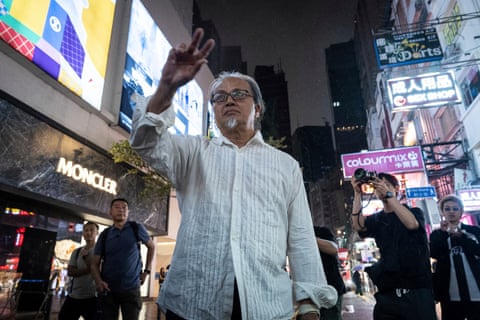
Hong Kong police detained an artist on Monday night after he appeared to write “8964” in the air with his hand, a reference to the Tiananmen Square massacre date, just hours before the 35th anniversary on Tuesday.
Public acknowledgment of the events of June 4, 1989, when Chinese soldiers violently ended a weeks-long peaceful protest, resulting in the deaths of several hundred to several thousand people, is banned in mainland China and increasingly sensitive in Hong Kong.
The artist, Sanmu Chen, was standing outside Causeway Bay station, surrounded by media, when he made the apparent tribute to the massacre. He also mimed pouring wine on the ground, a Chinese tradition for mourning the dead.
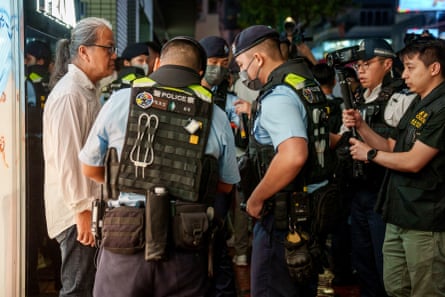
Police officers soon arrived and escorted him into a police bus. A Hong Kong Police spokesperson told the Guardian they received a report about a man “causing a disturbance.” She said he was taken to the police station for inquiries but was later released “unconditionally.”
On Tuesday, Tiananmen Square in Beijing was closed. A notice on the ticketing website indicated that reservations to visit the area were suspended for the day, and previously booked tickets could be refunded. A resident informed Reuters that Chang’an Avenue, the main road adjacent to the square, was closed to cyclists and pedestrians.
Chinese state media did not mention the June 4 date, but some China-based English-language accounts on X attempted to spread claims on Tuesday that accounts of the massacre were Western disinformation. Both X and discussions of June 4, 1989, are banned within China.
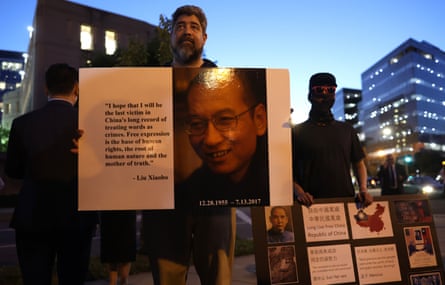
On the other hand, expatriate organizations have organized memorial services in Taiwan, the US, the UK, Australia, and other countries. Lai Ching-te, the president of Taiwan, honored the “students and citizens who bravely marched for change” on Tuesday.
In a statement circulated on social media, he stated, “The commemoration of June 4 is not only for the sake of June 4, but also because people around the world who care about democracy and freedom share a common belief: only democracy and freedom can truly protect the people.”
“People are free to express themselves in a truly respectable country.”
Human rights organizations reported on Monday that authorities in China and Hong Kong had detained or placed under observation a number of dissidents prior to the day.
Eight persons have been detained by Hong Kong police under a new national security law on suspicion of posting remarks with seditious intent prior to a “upcoming sensitive date.”
The biggest Tiananmen memorial gathering was staged in Hong Kong for thirty years, but it was also prohibited due to the city’s government’s increasing crackdown on the pro-democracy movement. It is still permissible for individuals to observe the day in private in their homes, according to two lawmakers from Hong Kong this week.
The Hong Kong Free Press was informed by Regina Ip, a legislator who supports Beijing, that it was “high time” that public celebrations of June 4th were discontinued because certain individuals had “preyed on the emotions of the people and weaponized June 4th commemorations” to incite animosity toward the Chinese government.
But she said, “I don’t think an offense is committed if a person does anything in private without intending to incite hatred of the government.”
Former pro-democracy lawmaker Debbie Chan, who now owns a small shop, said last week that after her company started handing away memorial candles, three different government agencies, including the police, had come. According to Hong Kong Free Press, Chan claimed that on June 4th, a police officer had approached her and inquired as to whether she was “going for a run.”
The Chinese central government now has much tighter control over the city, following years of the Hong Kong government’s crackdown. In prior years, attempts to hold candlelit vigils in houses and throughout the city have led to arrests, and locals fear that celebrating June 4th may soon become just as difficult for them as it is for people in mainland China.
Additional reporting by Chi-hui Lin